At Greenyard, sustainability is inseparable from our purpose of making life healthier by helping people enjoy fruit and vegetables at every moment of the day. As a company operating at the heart of the food value chain, we recognize our responsibility to contribute to a more sustainable food system while continuing to deliver value to our customers, growers, employees, investors and society.
Fruit and vegetables are widely recognised as the most sustainable food category, combining significant nutritional benefits with a low environmental footprint. As a company dedicated to increasing the consumption of fruit and vegetables, we significantly contribute to a healthier and more sustainable food system. At the same time, we believe that this does not diminish our responsibility to improve the sustainability of our own operations.
The past financial year was characterized by a challenging business environment, marked by ongoing economic uncertainty, cost pressures and a rapidly evolving regulatory landscape. At the same time, expectations from customers, consumers and policymakers continue to increase. Sustainability is not a separate agenda; it is a fundamental requirement for future growth, resilience and competitiveness. Against this backdrop, we have continued to invest in initiatives that strengthen both our business and our sustainability performance over the long term.
One of the defining characteristics of FY25/26 has been the progress made on several large-scale projects that will help shape the future of Greenyard. While smaller initiatives remain important, meaningful reductions in environmental impact increasingly depend on transformational investments capable of delivering step changes in performance. These projects often require years of preparation within a broad variety of internal teams, extensive engineering efforts and close cooperation with local authorities, regulators and partners before they can move forward.
This year, we began to see the results of that preparation. Across our divisions, several key projects reached important milestones. At Bakker, construction started on a new state-of-the-art fresh food centre in Ridderkerk, representing the largest investment in Greenyard’s history. The facility will bring together the latest innovations in warehousing, packing and ripening, while being built according to the highest sustainability standards. Alongside our continued electrification efforts, this investment will strengthen our ability to serve customers more efficiently, enhance operational excellence and support the long-term sustainability of our operations.
At Prepared, preparations and investments linked to renewable energy generation continued to move forward, including the wind turbine project. Beyond the direct generation of renewable electricity, this project creates opportunities for further electrification of processes that currently rely on fossil fuels, demonstrating how sustainability investments can generate multiple benefits simultaneously.
Within our Frozen division, significant progress was made on water management initiatives, including projects focused on water reuse and recycling. Water stewardship remains a critical priority for our business, particularly in a context where water scarcity is becoming an increasingly important challenge across many regions. The progress made towards new wastewater treatment solutions both in the Frozen and Prepared divisions represents another important step in our efforts to use water more responsibly and efficiently.
These examples illustrate an important reality: meaningful sustainability progress requires persistence and long-term commitment. Many of the projects that will deliver substantial environmental benefits cannot be realized overnight. They require vision, investment and patience. FY25/26 can therefore be seen as a year in which several long-awaited breakthroughs brought us closer to realizing the full potential of these initiatives.
As we conclude the period covered by our 2025 sustainability roadmap, it is also an appropriate moment to reflect on the progress we have achieved against the ambitions we set ourselves several years ago.
We reduced the CO₂ emissions from our own operations by 54% compared to our 2020/21 baseline, exceeding our target of 50%. We also achieved our target for water use within our operations and made strong progress towards our circular economy and responsible sourcing objectives. Some of our supply chain ambitions, however, proved more challenging than anticipated, offering valuable insights for setting more effective targets going forward.
While reviewing our progress against our 2025 objectives is important, sustainability is ultimately a longterm journey. The challenges facing our industry and society do not stop at a reporting milestone, nor do the opportunities to create positive impact. For that reason, the past year has also been dedicated to defining the next phase of our sustainability strategy and determining where we want to be by the end of this decade.
Our long-term vision remains clear: we aim to contribute to a more sustainable and resilient food system and play our part in shaping a healthier future. Building on our past performance and responding to a rapidly changing operating environment, we have refined our priorities for the years ahead. We remain ambitious for our own operations while setting targets that are realistic and achievable. At the same time, we will intensify our engagement in collaborative initiatives to scale shared sustainability ambitions across the produce value chain.
Across divisions, entities work in different market realities. Some entities operate in highly competitive, price-driven environments, while others collaborate closely with customers for whom sustainability is a top priority. This means our approach must be adaptable – ensuring responsible practices everywhere, while aiming for progress and leadership where it is realistic and impactful.
Another important development during the year was Greenyard’s transition to private ownership. This step was the result of a joint effort between the Deprez family and Solum Partners, bringing together the family’s decades of sector knowledge and long-term commitment to the company they built for over four decades, with Solum’s global expertise in food and agriculture investment. While our commitment to transparency and accountability remains unchanged, this new chapter provides an opportunity to further strengthen our focus on long-term value creation. We are pleased to work alongside Solum Partners, whose strong expertise and commitment to sustainability bring valuable perspectives and constructive challenge to our organization. Together, the Deprez family and Solum now reinforce one another, building on a clear view on sustainable growth guided by continuity of vision. Through ongoing dialogue between our teams and the Solum team, and by sharing best practices across their broader portfolio, we continue to enhance our understanding of emerging sustainability trends and opportunities.
The transition towards a more sustainable future cannot be achieved by any company acting alone. It requires collaboration across the entire value chain, from growers and suppliers to customers, technology partners and policymakers. The progress highlighted in this report reflects the collective efforts of many individuals and organizations who share our commitment to driving positive change.
I would therefore like to thank all Greenyard employees, growers, customers and partners for their continued dedication and support. Their expertise, commitment and perseverance enable us to translate our ambitions into concrete actions and measurable results.
As we look ahead, we remain confident in our ability to continue building a more sustainable, resilient and future-proof Greenyard. The progress achieved during FY25/26 demonstrates that with the right longterm vision, meaningful change is possible. We are committed to maintaining this momentum as we work towards our ambitions for 2030 and beyond.
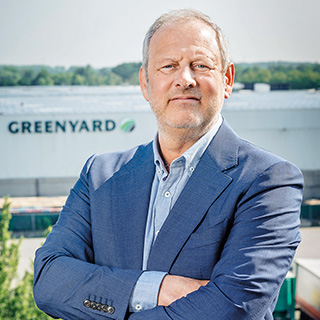
Francis Kint
Chief Executive Officer